eSIM vs Pocket WiFi vs Local SIM
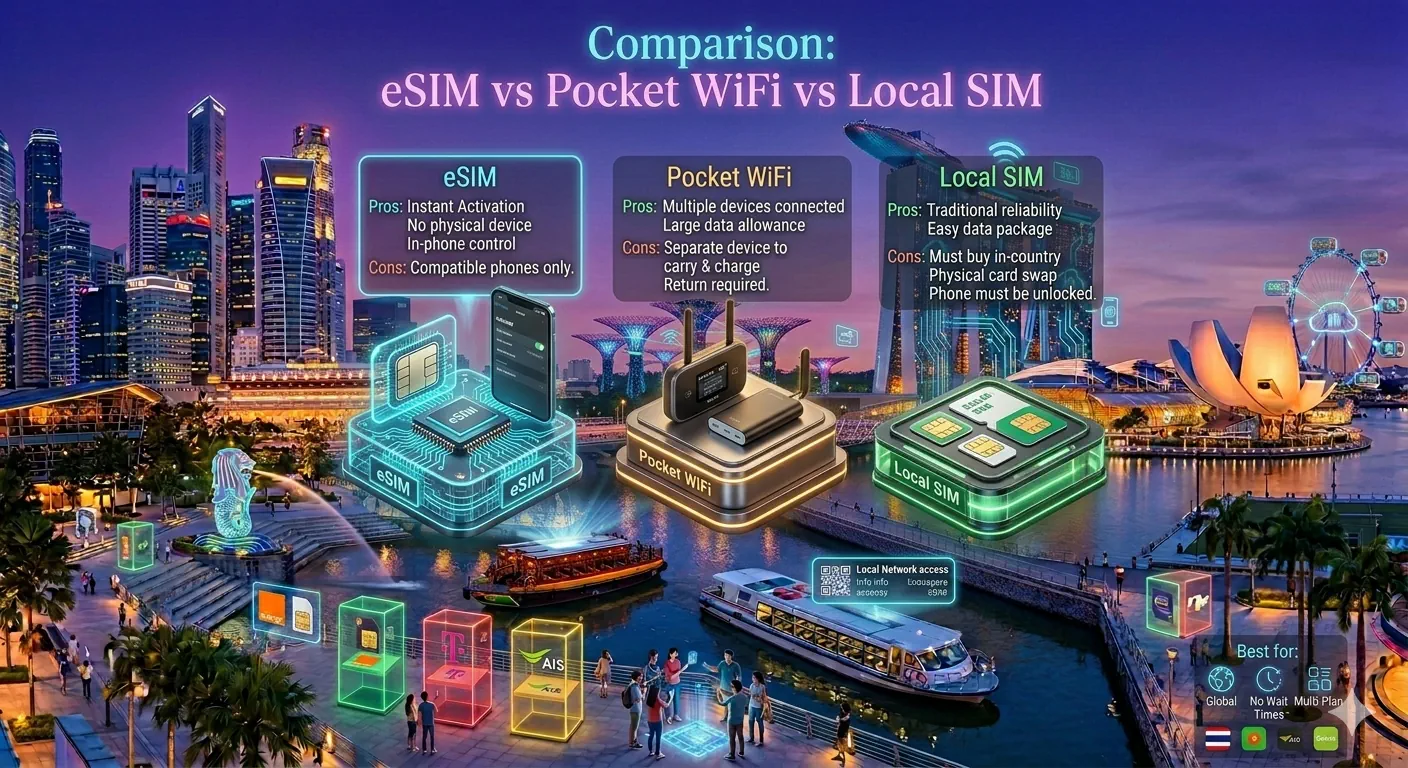
There are three sensible ways to get your phone online while travelling in Asia: a travel eSIM, a rented pocket WiFi device, or a local SIM card bought when you arrive. Each has a genuine case to make, and the right answer depends on how you travel and who you travel with. Here is the honest comparison, without pretending one option wins every time.
The quick version
| Option | Best for | Main drawback |
|---|---|---|
| eSIM | Solo and couple travellers who want zero hassle | Needs a compatible, unlocked phone |
| Pocket WiFi | Families and groups sharing one connection | Another gadget to charge, carry and return |
| Local SIM | Long stays where you want a local number | Airport queues and swapping out your home SIM |
Travel eSIM
An eSIM is a data plan you download to your phone before you fly, so you are connected the instant you land. There is nothing to collect, nothing to return, and nothing physical to lose. You keep your home SIM in the phone for calls and bank codes while the eSIM quietly handles your data.
For most solo travellers and couples, this is the path of least resistance. The cost is predictable, setup takes a couple of minutes, and there is no device to babysit. The one real catch is that your phone must support eSIM and must not be locked to your home carrier — which rules out some older and some heavily subsidised handsets. If your phone qualifies, an eSIM is hard to beat for convenience.
Our default recommendation
For most Asia trips we reach for a travel eSIM first. Providers like Airalo cover every country in our destination guides, and you can buy a top-up from your phone if you run low.
Pocket WiFi
A pocket WiFi is a small rented hotspot that broadcasts a private WiFi network several devices can join. You usually reserve it online, collect it at the airport or have it posted to your hotel, then return it at the end of the trip.
Where pocket WiFi shines is groups. If four people are travelling together, one device can keep everyone online and the per-person cost drops sharply. It also works with any phone, locked or not, and with devices that have no SIM slot at all, like most tablets and laptops.
The downsides are physical. It is one more thing to charge every night, one more thing to carry, and one more thing to return on time or pay a penalty. And because everyone shares one device, the group has to stay roughly together — wander off and you wander off the network. For solo travellers it rarely makes sense; for a family of four it can be the cheapest option going.
Local SIM card
Buying a physical SIM when you land is the traditional approach, and it still has a place. Local SIMs often bundle generous data and, crucially, a local phone number — useful for long stays, local deliveries, restaurant bookings, or any service that texts a domestic number.
The friction is in the getting. You queue at an airport counter or hunt down a phone shop, show your passport for registration, and physically swap out your home SIM — which means stashing that tiny card somewhere safe for a few weeks and losing access to your home number's texts. For a quick trip it is more effort than it is worth. For a month in one country where you want a local identity, it can be ideal.
So which should you choose?
Strip away the detail and it comes down to a few simple questions. Is your phone eSIM-capable and unlocked, and are you travelling solo or as a couple? Choose an eSIM. Are you a family or group happy to share one connection? Pocket WiFi will likely be cheapest. Are you staying for weeks and want a local number? A local SIM earns its place.
For the trips most of our readers take — one or two people, a week or two in Japan, Thailand or Vietnam — the eSIM wins on convenience often enough that it is our default suggestion.
Whichever you lean toward, our destination guides break down how much data you actually need per country, and if you are brand new to the technology, start with what an eSIM is and how it works.